

Consensus Review
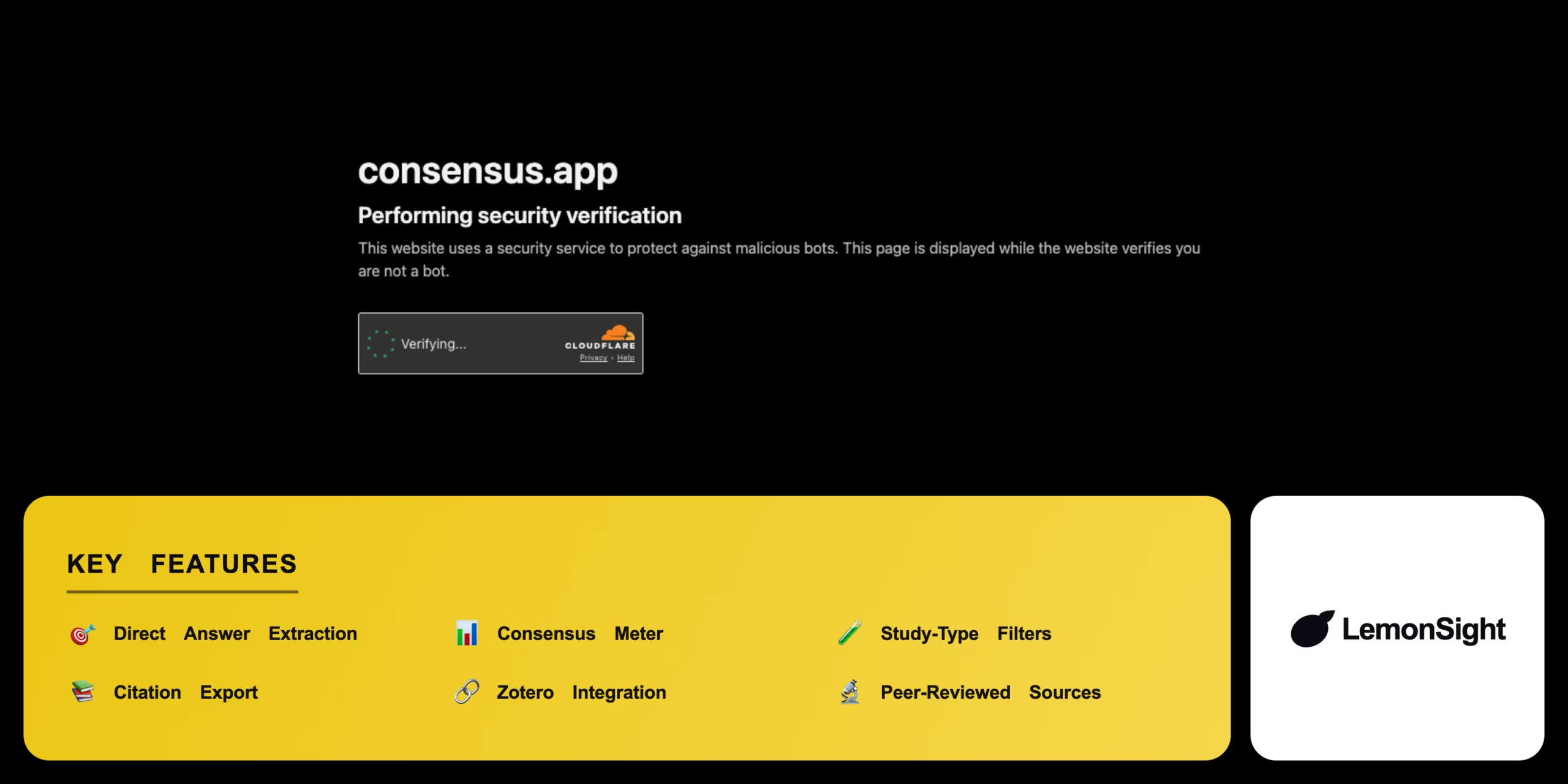
An AI-powered academic search engine that extracts direct answers from over 200 million peer-reviewed papers and synthesizes scientific consensus.
Is Consensus Worth It?
Consensus is worth it for researchers who need fast, verified literature reviews. By strictly sourcing from peer-reviewed papers and surfacing a Consensus Meter (Yes/No/Possibly), it largely eliminates the hallucination risk of general-purpose chatbots for academic questions. Coverage thins out on hyper-recent findings and non-STEM humanities topics, and full-text access behind paywalls is limited.
About Consensus
Consensus is an AI-powered search engine that automates academic research and literature reviews for students and scientists. It operates via a web interface to scan over 200 million peer-reviewed papers and extract direct answers to research questions, targeting academics who want to synthesize scientific findings quickly.
Consensus uses semantic search trained on the Semantic Scholar database, analyzing abstracts and conclusions to determine overall scientific consensus and categorizing findings as Yes, No, or Possibly via its “Consensus Meter.” Users can filter by study type and publication year, export citations in APA/MLA/Chicago format, and integrate directly with Zotero.
Is Consensus safe and reliable?
Consensus is generally safe, prioritizing accuracy by strictly pulling from the Semantic Scholar database rather than generating open-ended text, and it does not use user query data to train foundational models.
Our Verdict
Pros
- Eliminates AI hallucinations by sourcing real papers
- Provides rapid synthesis of conflicting studies
- Excellent integration with standard citation formats
- Consensus Meter summarizes scientific agreement fast
- Filters by study type (e.g. randomized controlled trials)
Cons
- Limited coverage of non-STEM humanities subjects
- Free plan includes restrictive search limits
- Does not read full texts behind publisher paywalls
- No public API for independent developers
- Struggles with hyper-recent or hyper-niche topics
How It Works
Create account
Sign up on the Consensus web platform.
Ask a question
Type a specific research question.
Read the summary
Review the AI-generated answer.
Check the Meter
Gauge overall agreement via the Consensus Meter.
Filter
Restrict to RCTs or recent publication years.
Read the source
Click a paper to see the exact extracted quote.
Export
Export the citation or save to Zotero.
Consensus Features
Direct Answer Extraction
Pulls exact sentences from papers.
Consensus Meter
Synthesizes agreement across studies.
Study-Type Filters
Filters by RCTs, year, and journal quartile.
Citation Export
APA, MLA, and Chicago formats.
Zotero Integration
Syncs directly with reference managers.
Consensus Pricing
- Unlimited AI synthesis
- Advanced study filters
- Consensus Meter access
- Zotero integration
Who Is Consensus Best For?
Fast, sourced answers for literature reviews.
Evidence-based answers to clinical questions.
Synthesize conflicting studies quickly.
Consensus Alternatives
| Tool | Best for | Price | Notes | Compare |
|---|---|---|---|---|
| Elicit | Deep data extraction | Free + paid | Free tier available | vs → |
| Perplexity | Broad web + academic | Free + $20/mo | Free tier available | vs → |
| Consensus — this review | Peer-reviewed synthesis | Free + $11.99/mo | Free tier available |
Consensus vs Elicit
Elicit pulls specific variables and methodologies into comparative tables for deeper extraction; Consensus focuses on fast, sourced yes/no/possibly synthesis. Deep data extraction → Elicit; fast verified answers → Consensus.
Consensus FAQ
Is Consensus free?
Consensus has a free tier with limited AI searches and synthesis. Premium at $11.99/month unlocks unlimited searches and advanced study-type filters.
Is Consensus accurate?
Consensus is generally accurate because it extracts direct quotes from peer-reviewed papers rather than generating open-ended text, reducing hallucination risk.
What is the Consensus Meter?
The Consensus Meter synthesizes multiple studies on a topic into a single Yes/No/Possibly indicator of overall scientific agreement.
Does Consensus read full papers?
Consensus primarily analyzes abstracts and conclusions and does not read full texts behind publisher paywalls.
Ready to try Consensus?
Start free, or take the trial to explore premium features across all your devices.
Visit Consensus →Related Tools

An AI homework helper, formerly known as Gauthmath, that scans a photo of a math or science problem and returns a step-by-step solution.
An AI language-learning app that pairs short video lessons with live spoken conversation practice against an AI tutor called the Speak Tutor.

A freelance academic writing marketplace that connects students with writers via an open bidding system, escrow payments, and a built-in plagiarism checker.

An AI learning platform that turns lecture notes, slides, and videos into flashcards, quizzes, and study guides, with a Spark.e AI tutor for Q&A.
A mobile AI math solver that scans handwritten or printed equations with a smartphone camera and returns step-by-step solutions.

Khan Academy's AI tutor and teaching assistant that guides students with a Socratic method and helps teachers plan lessons.