
Clay Review
A GTM data platform that builds prospect lists in spreadsheet-style tables and enriches every row by waterfalling queries across 200+ data providers, with Claygent AI agents filling in fields no provider sells.
Is Clay Worth It?
Clay is worth it for GTM and RevOps teams that need data coverage no single vendor can deliver. Waterfall enrichment queries 200+ data providers in sequence, and Claygent’s AI research agents catch custom fields no provider sells outright. The tradeoff is a data-credits-and-actions billing model that charges for failed lookups, so a team without someone to own the workflow will burn budget fast. Unlimited seats on a free, feature-complete plan make the evaluation cheap before committing to a paid tier.
About Clay
Clay (clay.com) is a go-to-market data platform that builds prospect lists inside spreadsheet-style tables and enriches every row by querying third-party data providers in sequence. Clay owns no contact database of its own: it resells access to more than 200 data and AI vendors, including email finders like Hunter, firmographic providers like Clearbit, and contact databases like ZoomInfo, then pushes the verified result into a CRM or email sequencer.
The core mechanic is waterfall enrichment, which falls through providers one after another and stops at the first match, lifting coverage above what any single vendor can return. Claygent, Clay’s AI research agent, sits on top of the waterfall and reads the open web, company sites, and LinkedIn profiles to fill in custom data points that no provider sells as a standard field. Both are available on every plan, including the free tier.
How does Clay’s data credits and actions billing work?
Clay bills in two currencies: data credits, spent only when a provider returns a match, and actions, spent every time a step runs whether or not it finds anyone. A five-provider waterfall over 1,000 contacts burns 5,000 actions regardless of hit rate, which makes the real cost of a deep waterfall hard to predict from the sticker price alone. Clay prices every plan per workspace with unlimited seats, so a subscription buys a credit and action allowance rather than a headcount license.
Clay is a private, venture-backed New York company, and it reports more than 10,000 customers including OpenAI, Canva, Anthropic, and Rippling. It holds SOC 2 Type 2 certification and states GDPR and CCPA compliance for the platform itself, though the lawful basis for contacting any enriched record still sits with the buyer, since compliance follows whichever third-party providers are switched on inside a given waterfall.
Our Verdict
Pros
- Waterfall coverage spans 200+ data providers, beyond what any single vendor matches
- Claygent AI research returns custom fields no data provider sells
- Workspace pricing includes unlimited seats on every tier
- Free plan runs without expiry and keeps full feature capability
- Pushes enriched rows straight into a CRM, sequencer, or ad audience
Cons
- Data credits and actions billing charges for failed lookups, not just results
- Learning curve assumes someone owns the waterfall and table builds
- Coverage depends on third-party providers, since Clay owns no database
- Compliance posture follows each enabled provider rather than Clay itself
- Cost per record can exceed a provider’s own API through credit arbitrage
How It Works
Create a workspace
Sign up for Clay and open a new workspace.
Start a table
Begin from a Clay template or a blank sheet.
Build the list
Import a CSV of target accounts or run a Clay audience search.
Add enrichment columns
Select a provider waterfall and order providers cheapest-first.
Run Claygent
Add a research column for fields no provider returns.
Sync to CRM
Push verified rows to HubSpot, Salesforce, or the Clay Sequencer.
Clay Features
Waterfall enrichment
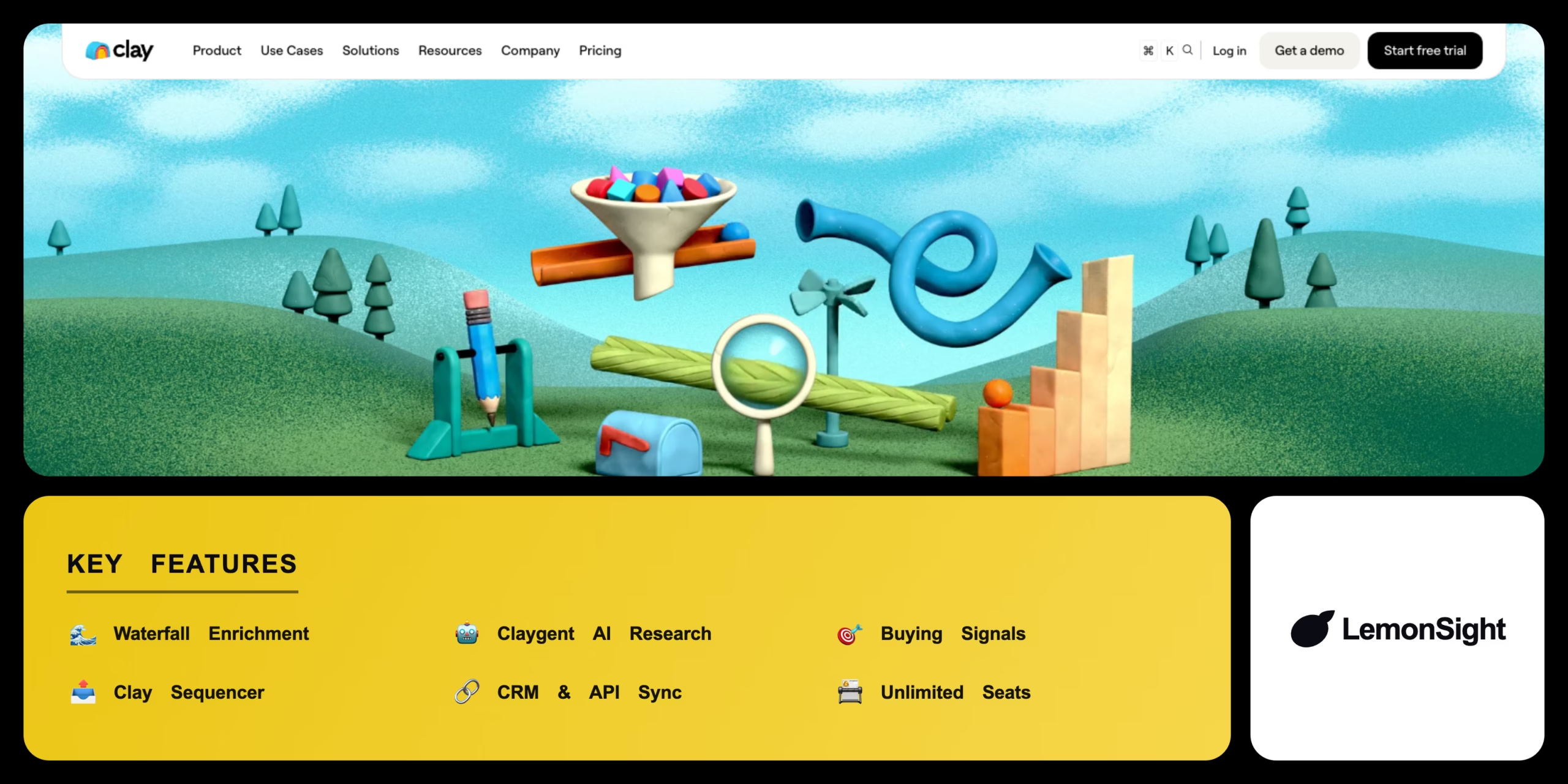
Queries 200+ data providers in sequence until a record is found.
Claygent AI research
Reads the open web and LinkedIn to return custom data points no provider sells.
Buying signals
Flags job changes, funding news, and web intent to score accounts.
Clay Sequencer
Sends email natively from a Clay table without a third-party tool.
CRM and API sync
Pushes enriched rows to HubSpot, Salesforce, or a custom system via the API.
Clay Pricing
- 30,000 credits/yr
- Phone number enrichment
- Job-change signals
- 50,000 rows/table
- 72,000 credits/yr
- CRM & warehouse auto-sync
- HTTP API & webhooks
- Web intent signals
- SSO & RBAC
- Unlimited bulk enrichment
- Annual commitment
- Dedicated support
Who Is Clay Best For?
Someone owns the waterfall build and workflow maintenance.
The free plan carries the full feature set for ICP validation.
One workspace prices by credits, not per-operator seats.
Clay Alternatives
| Tool | Best for | Price | Notes | Compare |
|---|---|---|---|---|
| Apollo.io | All-in-one contact database with a sequencer | Not confirmed | Not confirmed | vs → |
| ZoomInfo | Enterprise-grade verified data and intent | Not confirmed | Not confirmed | vs → |
| Instantly | Cold-email deliverability and inbox warm-up | Not confirmed | Not confirmed | vs → |
| Smartlead | Multi-inbox cold-email sending engine | Not confirmed | Not confirmed | vs → |
| Clay — this review | Waterfall enrichment across 200+ data providers | Free plan available; Launch from $167/mo | Yes, unlimited seats and tables |
Clay vs Apollo.io
Apollo.io sells its own contact database with a sequencer attached, while Clay sells access to 200+ third-party databases at once through waterfall enrichment. Apollo prices from a per-seat entry point while Clay prices a workspace credit allowance, so the two aren't directly comparable. Choose Apollo.io for one all-in-one tool, choose Clay to lift coverage on the records Apollo misses.
Clay FAQ
Is Clay free?
Clay’s free plan is free forever and feature-complete, capped at 100 data credits and 500 actions a month across 200 rows per table. It includes unlimited seats, unlimited tables, waterfall enrichment, Claygent, and the Clay Sequencer.
How much does Clay cost?
Clay costs from $167 per month on Launch and from $446 per month on Growth, both billed annually, with a custom Enterprise tier above them. Pricing runs per workspace with unlimited seats, so the bill scales with data credits and actions consumed rather than headcount.
Does Clay replace Apollo or ZoomInfo?
Clay does not replace Apollo or ZoomInfo, because it owns no contact database and instead buys records from many providers at once. Most teams add Clay to lift coverage on the records their existing tools miss.
What is Claygent?
Claygent is Clay’s AI research agent that reads the open web, company sites, and LinkedIn profiles to return custom data points that no data provider sells as a standard field. Each Claygent run consumes credits per row.
Ready to try Clay?
Start free, or take the trial to explore premium features across all your devices.
Visit Clay →Related Tools

A sales CRM built around a visual drag-and-drop pipeline, with workflow automation and an AI Sales Assistant layered on top.

An omnichannel customer service and sales CRM that centralizes email, chat, social, and phone support into one ticketing workspace with AI-driven routing.

An AI-powered document processing tool that extracts structured data from invoices, receipts, and PDFs into accounting and ERP systems.

A B2B contact database and sales intelligence platform that provides verified direct-dial phone numbers, emails, and buyer-intent signals for sales teams.

An embodied-AI company building general-purpose humanoid robots (Phoenix) and the Carbon AI control system for industrial and commercial labor.
An AI-powered legal assistant that drafts, reviews, and redlines contracts inside Microsoft Word.