

Modal Review
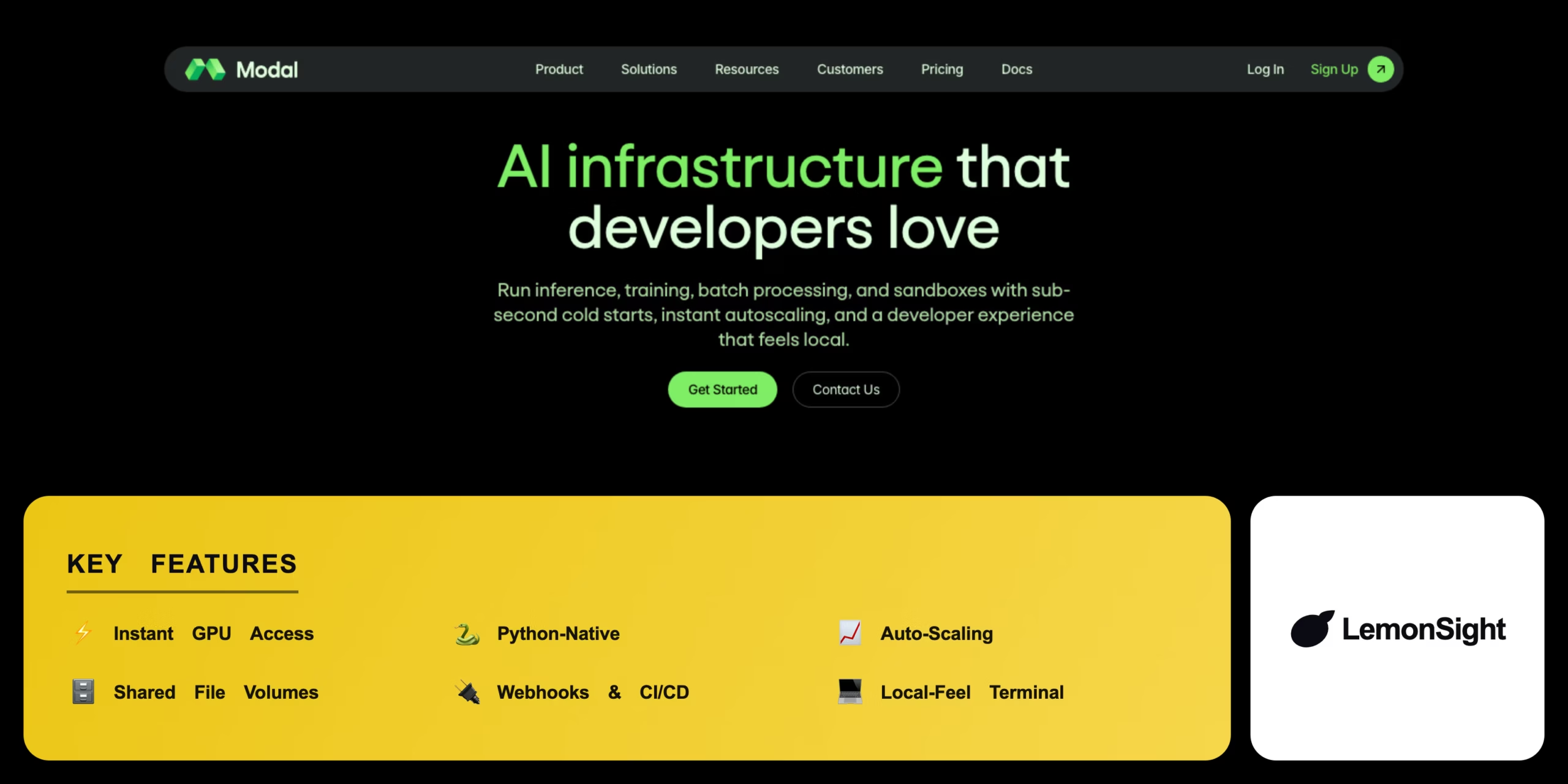
A serverless computing platform that provisions cloud GPUs in seconds for Python AI workloads, with no containers or Kubernetes required.
Is Modal Worth It?
Modal is worth it for AI developers who need to deploy models or heavy compute without infrastructure overhead. Cloud GPUs provision in seconds via simple Python decorators, eliminating Dockerfiles and Terraform, and it scales to zero automatically when idle. It’s Python-only with no visual interface, so non-technical teams and no-code builders should look elsewhere.
About Modal
Modal is a serverless computing platform that automates cloud infrastructure provisioning, GPU scaling, and AI model deployment for software developers. It targets AI engineers and data scientists who want to run Python code in the cloud without managing containers or Kubernetes clusters.
Modal uses a custom container runtime built for rapid cold starts and high-density GPU virtualization, executing local Python functions in the cloud instantly via decorators. It excels at deploying LLMs, running Stable Diffusion, and massive parallel data jobs, provisioning GPUs like the A100 and H100 automatically and scaling to zero when idle.
Is Modal safe for production code?
Modal is safe, implementing strict container isolation, encrypting data in transit, managing secrets through a centralized vault, and complying with standard cloud security practices and SOC 2 requirements.
Our Verdict
Pros
- Provisions high-end GPUs (A100/H100) instantly without manual cluster setup
- Eliminates the need to write or maintain Dockerfiles and YAML configs
- Scales from zero to thousands of containers automatically
- Provides a generous monthly free credit allowance for testing
- Streams logs to your local terminal as if running locally
Cons
- Requires proficiency in Python and command-line interfaces
- Restricts platform usage entirely to the Python ecosystem
- Experiences occasional GPU scarcity during hardware shortages
- Lacks a visual, no-code interface for deploying models
- Free credits don’t cover heavy or sustained production workloads
How It Works
Install
Run pip install modal.
Authenticate
Run modal setup in your terminal.
Write code
Write a standard Python function.
Add decorator
Add @app.function(gpu="T4") to request hardware.
Run
Run modal run your_script.py locally.
Watch
Stream execution logs from the cloud in real time.
Deploy
Run modal deploy for a permanent web API.
Modal Features
Instant GPU Access
Provisions A100/H100 GPUs in seconds.
Python-Native
Deploy via decorators, no Dockerfiles needed.
Auto-Scaling
Scales from zero to thousands of containers.
Shared File Volumes
Stores massive model weights across runs.
Webhooks & CI/CD
Triggers from GitHub Actions or Stripe.
Modal Pricing
- $30/mo free credits
- Per-second billing
- Unlimited compute scaling
- Full Python SDK
- Shared billing accounts
- Centralized secrets
- Role-based access
- Team collaboration
Who Is Modal Best For?
Deploy open-source LLMs and Stable Diffusion as scalable APIs.
Run massive parallel data jobs across cloud CPUs.
Host Python apps and cron jobs without server management.
Modal Alternatives
| Tool | Best for | Price | Notes | Compare |
|---|---|---|---|---|
| Replicate | Pre-built model APIs | Pay-as-you-go | Free tier available | vs → |
| Baseten | Enterprise model hosting | Pay-as-you-go | Free tier available | vs → |
| AWS SageMaker | Large enterprise ecosystems | Pay-as-you-go | Free tier available | vs → |
| Modal — this review | Code-first serverless GPUs | Free + PAYG | Free credits available |
Modal vs Replicate
Replicate offers pre-built APIs for thousands of open-source models with no custom code; Modal gives full Python execution flexibility for custom deployment logic. Pre-packaged inference → Replicate; custom code-first deployment → Modal.
Modal FAQ
Is Modal free?
Modal is not fully free for unlimited use but provides a generous monthly free credit allowance (typically $30). Beyond that, it charges pay-as-you-go per second of compute.
Is Modal accurate?
Modal executes user-defined code identically to local environments; its output accuracy depends entirely on the models and logic a developer deploys.
Does Modal need Docker?
No. Modal lets developers define container environments entirely within Python code rather than writing Dockerfiles.
What GPUs does Modal support?
Modal provides instant serverless access to high-end GPUs including the NVIDIA A100, H100, and T4.
Ready to try Modal?
Start free, or take the trial to explore premium features across all your devices.
Visit Modal →Related Tools

Botpress is an open-source, LLM-native platform for building and deploying AI agents, pairing a visual Agent Studio with an Autonomous Engine and a free pay-as-you-go tier.

An end-to-end LLM development platform that bundles prompt engineering, a visual workflow builder, an evaluation framework, RAG retrieval and production monitoring for teams shipping AI features.
Phind was an AI answer engine for developers that shut down on 16 January 2026, and phind.com now returns a 404 with no product left to use.

A free, open-source TypeScript and Node.js ORM that generates a fully type-safe database client from a declarative schema file.

A developer-centric orchestration platform for building low-latency conversational voice AI agents, connecting STT, LLM, and TTS providers into one pipeline.

An AI-powered code review assistant that automatically analyzes pull requests, catches bugs, and suggests fixes directly in GitHub, GitLab, and Bitbucket.