

HubSpot Review
A CRM and marketing platform that automates sales tracking, email marketing, and customer service from one unified database.
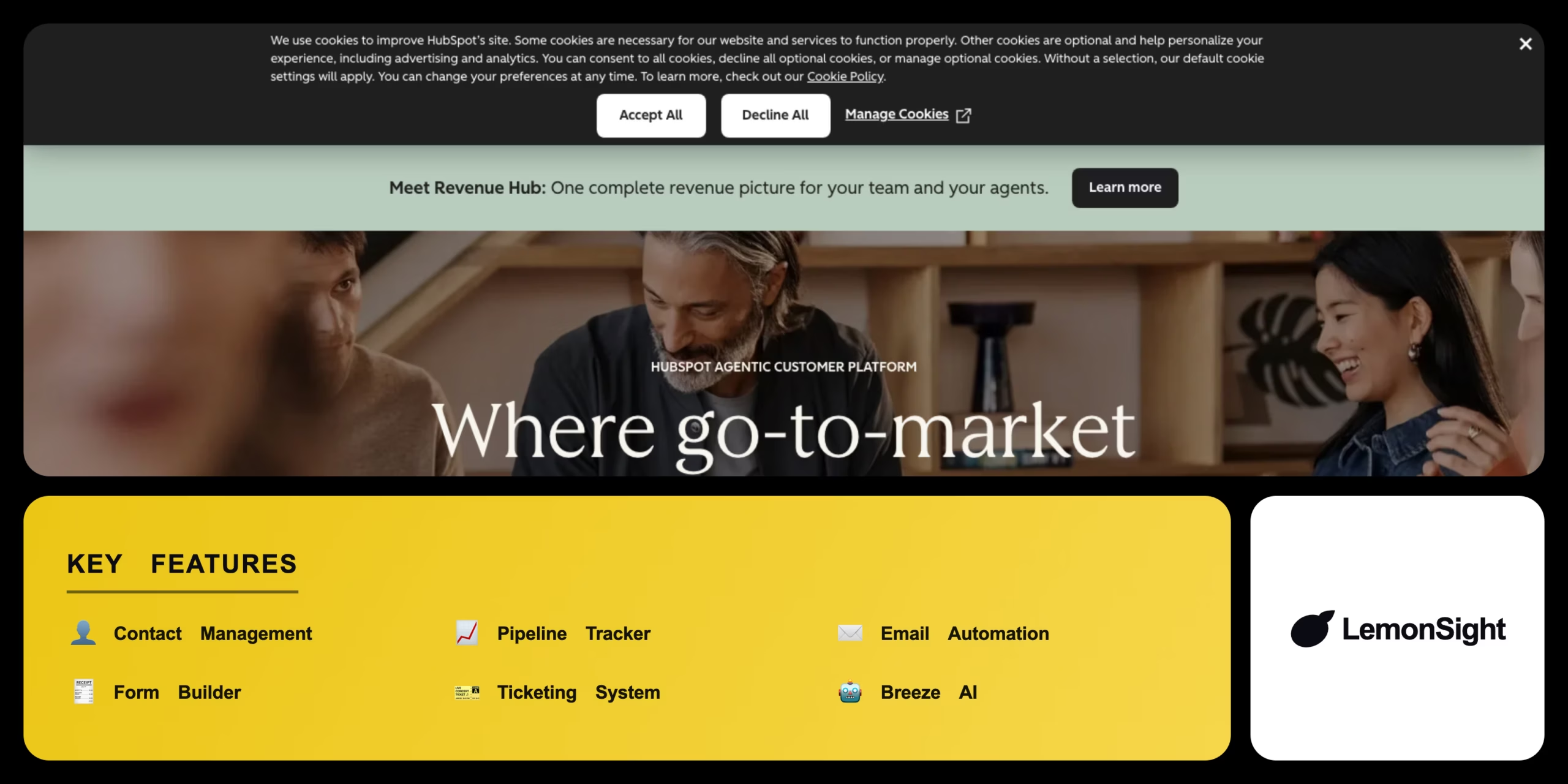
Is HubSpot Worth It?
HubSpot is worth it for startups, marketing teams, and growing sales organizations that need a unified customer database. It combines CRM, email automation, sales pipelines, and Breeze AI in one system, with Starter from $15/seat/month. The free HubSpot CRM covers basic contact management at no cost; the jump to Professional ($800/mo) is steep.
About HubSpot
HubSpot is a customer relationship management (CRM) platform that automates sales tracking, email marketing, and customer service for growing businesses. Brian Halligan and Dharmesh Shah co-founded HubSpot in 2006, and it operates from Cambridge, Massachusetts as a publicly traded company (NYSE: HUBS) serving small businesses, marketing teams, and enterprise sales operations.
It centers on a free CRM for contact management, with paid Marketing, Sales, and Service Hubs layered on top. HubSpot Breeze AI generates email copy and blog drafts, scores leads, and automates database records across every hub.
Is HubSpot safe, secure & legit?
HubSpot is safe and legitimate, with SOC 2 Type II compliance and global data-protection controls. It encrypts customer data in transit and at rest, complies with GDPR and CCPA, and adds SSO, audit logs, and ISO 27001 on Enterprise. HubSpot, Inc. operates under a verified privacy policy.
Our Verdict
Pros
- Integrated database, sales, and marketing hubs
- Free core CRM for unlimited users
- Simple interface and fast onboarding
- Breeze AI for content drafting and enrichment
- SOC 2 Type II and GDPR compliance
Cons
- Steep price jump from Starter to Professional
- Free plan limits reports and form customization
- Seat minimums apply to paid hubs
- Contact limits can increase monthly costs
- Advanced customization needs developer help
How It Works
Sign up
Visit hubspot.com and register with a business email or Google.
Choose
Select the free CRM or start a paid hub trial.
Import
Import contacts from a CSV or connect a Gmail inbox.
Build pipelines
Set up deal pipelines and configure sales stages.
Capture leads
Create a lead form and embed it on a website.
Use Breeze
Open Breeze AI to draft marketing emails or landing-page copy.
Track
Monitor sales activity and deal status on the dashboard.
HubSpot Features
Contact Management
Stores and updates customer contact profiles.
Pipeline Tracker
Monitors deal status and sales progress.
Email Automation
Drafts and sends automated marketing campaigns.
Form Builder
Creates lead-capture forms for websites.
Ticketing System
Organizes and routes support tickets.
Breeze AI
Generates text and automates database tasks.
Landing Pages
Builds custom web pages for lead capture.
Mobile App
Syncs CRM data to iOS and Android.
HubSpot Pricing
- Unlimited users
- 1,000 marketing contacts
- Lead forms, email & ticketing
- Includes HubSpot branding
- $20/mo billed monthly
- Branding removed
- Simple email automation
- Up to 3 seats
- Custom reporting & workflows
- Predictive lead scoring
Who Is HubSpot Best For?
Manage contacts with a free core database; track early deals and send simple campaigns.
Align both teams on one database; generate leads via forms and automate email sequences.
Route tickets, track resolution times, and host customer portals.
HubSpot Alternatives
| Tool | Best for | Price | Notes | Compare |
|---|---|---|---|---|
| Salesforce | Enterprise customization | $25/user/mo | No free tier | vs → |
| Zoho CRM | Cost-effective database | $14/user/mo | Free tier available | vs → |
| Mailchimp | Email marketing automation | $13/user/mo | Free tier available | vs → |
| HubSpot — this review | Usability & integrated hubs | From $15/seat/mo | Free CRM |
HubSpot vs Salesforce
Salesforce structures databases for highly customized enterprise workflows and needs dedicated admins; HubSpot focuses on rapid setup, a cleaner UI, and self-service management. Database-heavy enterprises → Salesforce; growing teams → HubSpot.
HubSpot FAQ
Is HubSpot CRM actually free?
HubSpot offers a free version of its core CRM with basic contact management and email tools. The free plan has strict limits on contact storage and reports, and premium hubs start from $15 per month.
What is HubSpot used for?
HubSpot is used for managing customer databases, automating email marketing campaigns, and tracking sales pipelines, centralizing marketing, sales, and service tools in one system.
Is HubSpot hard to learn?
HubSpot has a moderate learning curve and is generally easier to use than enterprise alternatives like Salesforce. Free training and certifications are available through HubSpot Academy.
Who owns HubSpot?
HubSpot, Inc. owns HubSpot, founded by Brian Halligan and Dharmesh Shah in 2006. The public company is headquartered in Cambridge, Massachusetts.
Is HubSpot safe?
HubSpot is safe to use, encrypting customer data in transit and at rest and maintaining SOC 2 compliance. The company follows GDPR guidelines for contact permissions.
Ready to try HubSpot?
Start free, or take the trial to explore premium features across all your devices.
Visit HubSpot →Related Tools

A marketing automation platform that combines email, SMS, and a built-in CRM with machine-learning predictive sending and Site Tracking.

A social media management platform that centralizes scheduling, engagement, and analytics across networks with OwlyWriter AI caption generation.

An email marketing platform for online creators to automate campaigns, build landing pages, and sell digital products via a tag-based system.

An AI YouTube growth tool for keyword research, SEO scoring, and competitor tracking via a browser extension and dashboard.

A social media management platform that schedules posts, measures performance, and drafts captions with an AI assistant across all major networks.

An ecommerce marketing automation platform that coordinates email, SMS, and push campaigns with real-time store data.